Rethinking Philippine urbanism through Nolan Gray’s "Arbitrary Lines"
For decades, the standard toolkit to manage the direction of urban growth has centered on a single, colorful map: the Zoning Ordinance (ZO). We are taught that a healthy city is one where "like" stays with "like," i.e., residential here, commercial there, and industry tucked far away. But as our metropolitan centers struggle under the weight of millions in housing backlog, crippling traffic, and a deepening divide between the gated enclave and the informal settlement, a radical question is emerging: Is the ZO map itself the problem?
In his book "Arbitrary Lines: How Zoning Broke the American City and How to Fix It," Nolan Gray argues that zoning is not merely a flawed system in need of reform; it is a failed experiment that should be abolished. When we translate Gray’s arguments into the Philippine context, we find a startlingly relevant critique of how our rigid land-use regulations often stifle the organic vitality our cities need to survive.
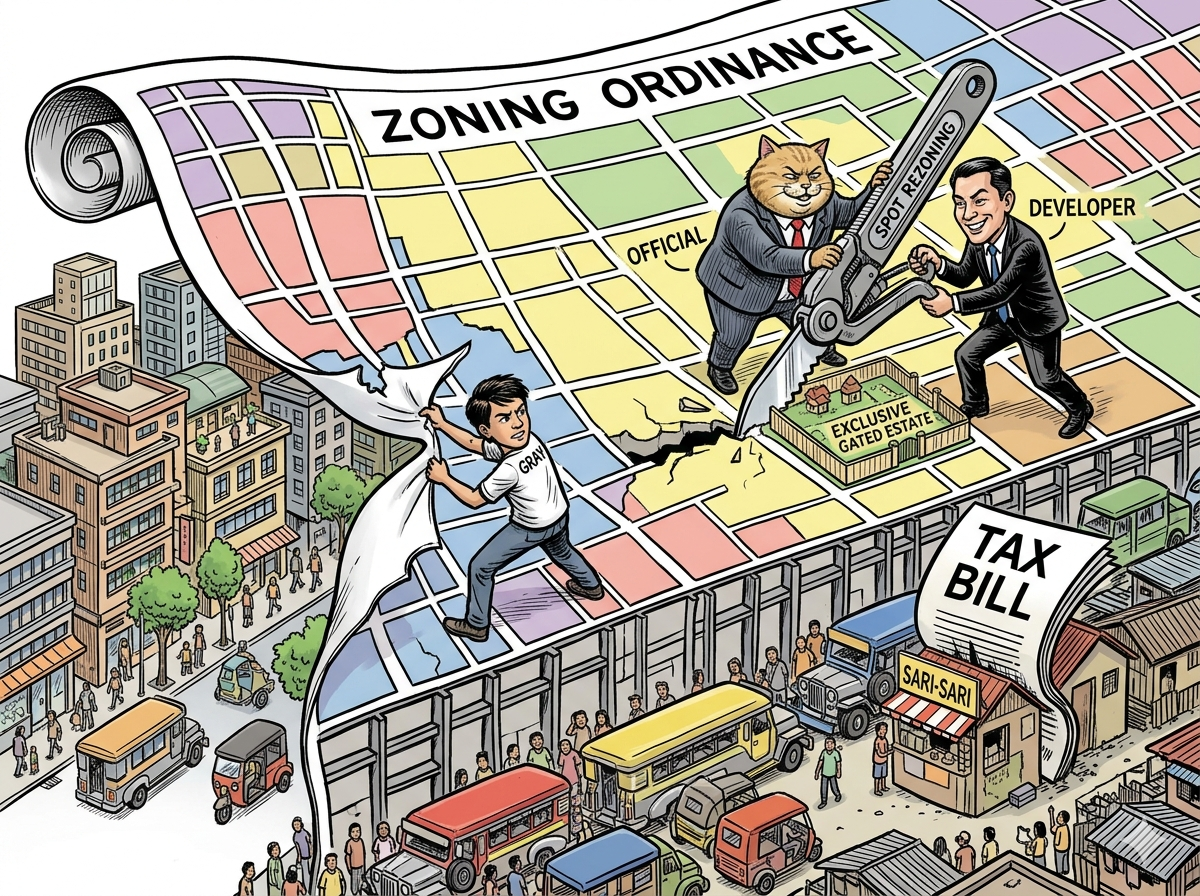
The most critical point Gray makes is that "zoning" and "planning" are not synonyms. Planning is a proactive, essential function of the State. It involves balancing the built form and the unbuilt environment, and designing the sustainability of the unbuilt environment without compromising the development needs of the built form. Conversely, zoning is a reactive and exclusionary mechanism. It is a set of "thou-shalt-nots" that supposedly translate the plans into ironclad legal prohibitions.
In the Philippines, this distinction is often blurred within the Comprehensive Land Use Plan (CLUP). While the CLUP is intended to be a visionary document, it is frequently reduced to its zoning component: a static, color-coded map attached to the local ordinance that attempts to freeze a city in time. This approach treats the city like a machine with fixed parts rather than a living, breathing organism. When we prioritize the rigid boundaries of a zone over the actual needs of the people, we end up with "arbitrary lines" that ignore how cities actually grow.
High cost of exclusionary lines
One of Gray’s stinging critiques is that zoning is a primary engine of the housing affordability crisis. By mandating low-density development such as large minimum lot sizes and "single-family residential" or R-1 zones, zoning artificially restricts the supply of land. When supply is capped but demand continues to soar, prices inevitably skyrocket.
In the Philippine context, this is visible in our "exclusive" gated subdivisions. These areas occupy massive tracts of prime urban land but are legally restricted to low-density housing. This forces the majority of the working class to the urban fringes, necessitating four-hour commutes from provinces like Cavite or Bulacan into the central business districts of Metro Manila. Abolishing these density caps would allow for the "missing middle," more vertical higher density affordable housing units to be built within existing neighborhoods, creating more diverse, walkable communities.
Formality, the "sari-sari" economy, and the fiscal trap
The Philippines is a nation of "organic" urbanism. Much of our economic life happens in the informal sector, where a home is also a "sari-sari" store or a small workshop. To a traditional zoning officer, these are "non-conforming uses." These robust social and economic activities are the hallmarks of a functional city.
However, even when modern Philippine policy introduces "mixed-use" classifications, it often trips over its own bureaucracy. The gap between planning and practice is most visible in the fiscal arena. While a planner may designate an area as mixed-use, local assessors often fall back on the "dominant use" principle. If a family opens a shop in their home, an assessor might reclassify the entire property as "Commercial," leading to a massive jump in real property taxes. This creates a "fiscal trap." Residents are incentivized to keep their businesses hidden to avoid being crushed by misaligned tax assessments.
With the enactment of Republic Act No. 12001 or the Real Property Valuation and Assessment Reform Act (RPVARA) in 2024, this dilemma should be addressed. RPVARA mandates the "Actual Use" principle and the adoption of international valuation standards. By moving toward the digital tools mandated by RPVARA, such as the Real Property Information System (RPIS), planners and assessors can finally move away from the "dominant use" shortcut and reflect the nuanced, multi-functional nature of Filipino homes.
End of "spot-rezoning" and the urban sprawl
Perhaps the most insidious byproduct of rigid zoning in the Philippines is the practice of "spot-rezoning." This occurs when a specific parcel of land is granted an "exception" or a "reclassification" via a local ordinance to allow for a project that deviates from the CLUP.
Under our current system, the zoning map acts as a high wall. For the average citizen or small entrepreneur, this wall is insurmountable. However, for "powerful interests" like large developers with the political capital to lobby the local Sanggunian, the wall is porous. Spot-rezoning allows these players to bypass spatial plans, often placing high-intensity developments in areas where the infrastructure (roads, water, sewerage) is not prepared to handle them. This creates a "planning by exception" culture that demoralizes environmental planners and renders the hard-earned spatial strategies of the CLUP moot.
If we abolish the arbitrary "use" and "density" caps and replace them with clear, uniform "performance standards," we remove the leverage of the powerful. If the rules are: "You can build as much as you want provided you meet these height, safety, and infrastructure-impact standards," then there is no "exception" to sell.
Making the desired urban form (density and mixed-use) the default rather than a "special permit" levels the playing field. It prevents powerful interests from monopolizing the "right to build" and ensures that the city grows according to a transparent set of standards rather than a series of backroom deals that undermine the long-term vision of the CLUP.
But beyond economics and equity, zoning mandates car dependency. By separating where we live from where we work, zoning makes it difficult to build walkable, transit-oriented development. In the Philippines, this promotes urban sprawl that eats into agricultural land and increases our vulnerability to flooding. Abolishing rigid zoning would allow for higher density along transit corridors, creating a city that grows "in" rather than "out," preserving our natural resources and making public transport more viable for everyone.
Role of the Environmental Planner
If we abolish zoning, the role of the Environmental Planner becomes more vital than ever, transitioning from a "gatekeeper" to a "curator" of the public realm.
1. From Enforcement to Design: Planners can shift toward "Form-Based Codes," focusing on how buildings interact with the street rather than what happens inside them.
2. Managing Nuisances: We don't need a 300-page ordinance to prevent a factory next to a school. Planners would instead manage specific impacts like noise, odor, and vibration through robust nuisance laws.
3. Data-Driven Advocacy: Using RPVARA’s mandate for automation, planners can lead the integration of land-use data with tax data, ensuring that "Actual Use" is accurately captured and that the spatial intent of the city is protected from political interference.
Conclusion: Toward a more equitable horizon
Nolan Gray’s Arbitrary Lines challenges us to stop viewing the city as a series of static, segregated boxes. In the Philippines, his arguments offer a path toward a more equitable future. Abolishing zoning (and its vicious relative "spot-rezoning" that thrives in its shadows) does not mean a lack of order. It means replacing a 20th-century tool with a 21st-century approach that prioritizes people over property lines. It empowers the planner to stop policing land use and start being an architect of social and economic mobility. ###
