Poók Tipunan: The Walled City as a third place
Welcome to Poók Tipunan, a blog series exploring third places in the Philippines. Poók is a Filipino word that means a lived space, and tipunan is our word for convergence. Together they represent the vital public spaces where community takes root. Here we examine how to reclaim these third spaces through accessibility, walkability, and aesthetics. We advocate for an "ethic of care" in design, creating adaptive commons that invite the pedestrian to linger and connect. We seek to build cities that don't just house us, but hold us together as one community. Join us as we rediscover the sanctuaries where we truly belong.
The stone of Intramuros does not just sit; it breathes. On Maundy Thursday, I stepped through the massive gate, leaving the frantic hum of modern Manila for a world defined by the hard, gray limit of the curtain wall. I expected the silence of a museum at rest. Instead, I walked into a hive. The streets were not empty; they were occupied by a sea of fellow explorers, pilgrims, and families. Thousands of feet shuffled over sun-baked cobblestones. The Walled City had transformed from a museum into a shared living room.
A legible city
Intramuros is clearly defined by its edges, those formidable curtain walls and ramparts (hence the term "Walled City") that provide a clear sense of transition from the chaotic sprawl of modern Manila into a distinct district of history. The walls rose on either side, marking a deliberate edge. Within this container, the city follows a logic of paths and gateways. I turned onto General Luna Street, where the roar of internal combustion had been silenced. Pedestrianization is a triumph of the lungs. Without the barrier of cars, the street became a democratic channel. I watched families claim the center of the road. Explorers leaned against heritage facades; elders rested on stone ledges.
No one asked for credentials at the gate. The space functioned as a social leveler, where the only entry fee was the act of walking. But as I moved deeper into the grid, the sun hammered the pavement. I squinted, searching for a canopy of leaves. The few trees scattered along the route acted as islands of survival. Groups huddled in the narrow strips of shade cast by the buildings, their backs against the cooling stone. The heat rose from the ground in shimmering waves. While the path was clear and the safety absolute, the environment lacked comfort or ginhawa, the physical relief that turns a walk into a stay. To navigate this street was an act of endurance.
Geometry of sanctuaries
Historically, Intramuros functioned as a stone-clad triad: a military shield, a civilian enclave, and a cathedral city. The walls encircled the gears of colonial power, protected by a ring of cannons that pointed toward the Pasig River and the open water of Manila de Bay.
My first stop for the day was Baluarte de San Diego. After showing my Klook qr code to the sentry, I started my exploration of the remnants of this structure that was once a watchtower. Designed by the Jesuit priest Sedeño in the late 1580s, this bastion stands as the district's oldest structure. It was built to watch for enemies cresting the waves of Manila Bay, waves that once lapped against these very embankments before 20th-century reclamation pushed the shoreline back to make room for Roxas Boulevard, Manila Hotel, Quirino Grandstand, and the piers.
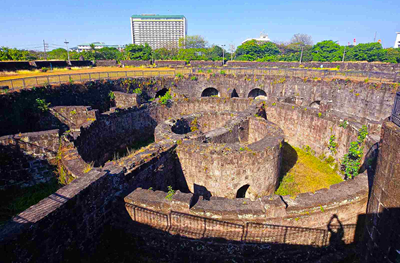
Baluarte de San Diego with the Manila Hotel at the background (photo by the author)
After spending some time alone quietly pondering the many invaders and pirates the Spaniards warded off using this structure, I returned to General Luna Street and joined the flock traversing the spine of the Walled City.
A few blocks away, Casa Manila stands as a stone-and-wood ledger of the ilustrado rise. These merchant families turned the Galleon Trade and the opening of tobacco routes between Manila and Acapulco into sudden, dizzying wealth. They filled these rooms with French mirrors and Italian chairs, aping their Spanish overlords until the mimicry turned into social leverage. Wealth bought more than just ornate decor; it bought passage to Europe for their children. Those students returned not just with degrees, but with the subversive ideas that eventually bloomed into the demand for independence in 1898.
In the center of this domestic history, that courtyard of the "Heneral Luna" fame provides a sanctuary. The temperature dropped as I crossed the threshold. Water trickled from a central fountain, a sound that cut through the external hum of the crowd. Here, the architecture did the heavy lifting of hospitality. The deep eaves and open corridors invited me to linger. I sat for a moment, watching strangers strike up conversations and taking their IG- and Tiktok-worthy shots near the stone well. This was the city as a neutral ground where the primary activity was simply being present among others.
But alas, my short respite has come to an end. I must continue walking under the heat of the sun to my next destination.
"Discovery" by accident
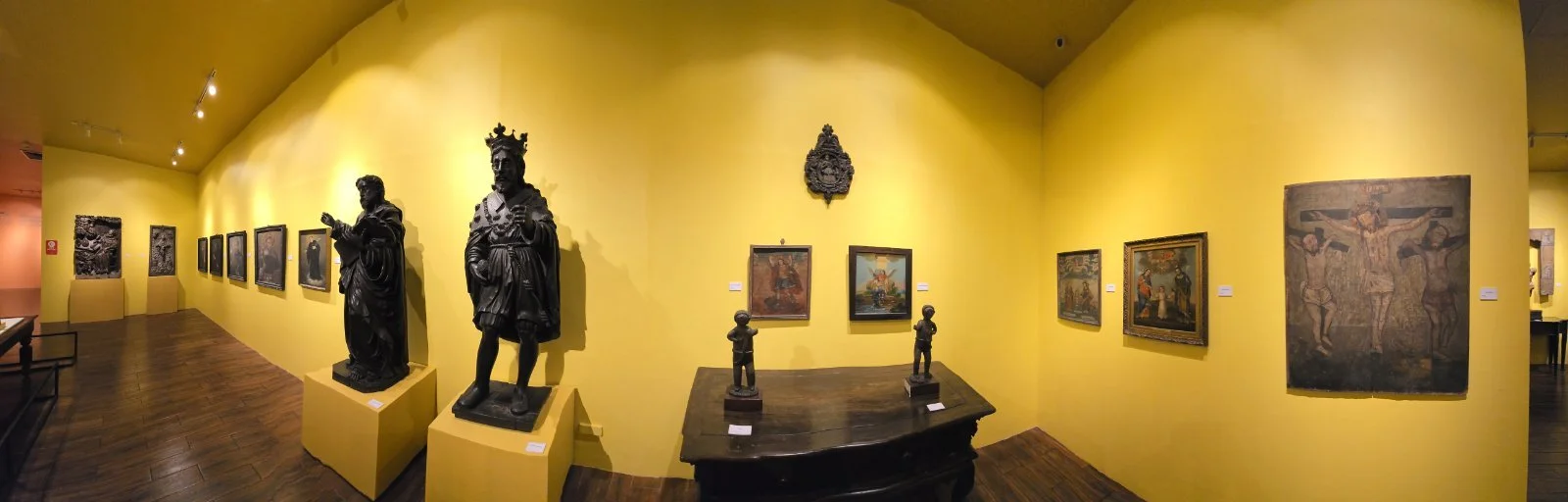
Inside the Centro de Turismo Intramuros and the Museo de Intramuros, the air-conditioned chill replaced the humid weight of the street. I stood before the rows of ivory saints and wooden altars. These were not just artifacts; they were the tools of a colonial recalibration. The exhibits highlight how religion was utilized as a tool of psychological and social subjugation, transforming the "indio" into a colonial subject.
I traced the maps of the Moluccas in the gallery. Magellan's fleet missed its mark for spices, and a 333-year trajectory began. I read the names etched into the history of the administration: Hapsburg, Bourbon. In far-away European courts, signatures were scrawled that redirected the galleons in the Pacific and reshaped the laws of this archipelago. We are a nation born from a maritime accident, then later evolved as the byproduct of distant dynastic squabbles. Yet, the people in the galleries around me claimed this history as their own. They didn't look like tourists; they looked like heirs inspecting an inheritance.
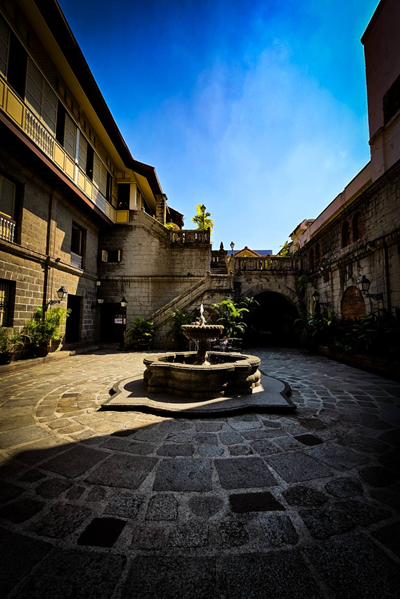
Casa Manila Museum Courtyard (where the scene of Gen. Antonio Luna’s murder in “Heneral Luna” was filmed/photo by the author)
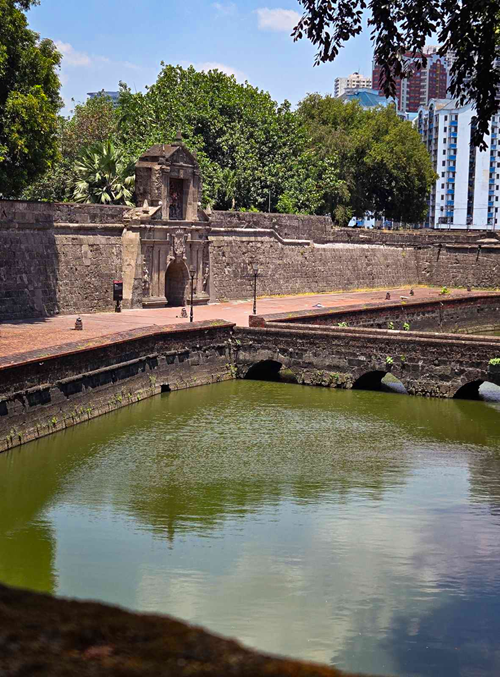
Entrance to the Fort Santiago (photo by the author)
Fortress of convergence
I finally reached Fort Santiago just as the sun was passing through its highest point in the day. I had expected a quiet fortress; I found a festival. The crowd surged toward the gate, but they didn't just pass through; they converged.
As I stood within the barracks, I felt the heavy shift from public square to hallowed ground. This is the place where our national hero was held, tried, and sentenced, eventually making that final, resolute walk to the barrels of a firing squad at the nearby fields of Bagumbayan.
The ground here carries a weight that the festive atmosphere cannot entirely mask. Below the feet of the visitors lie the dungeons: dark, damp prison cells that once held both military and civilian captives, Filipinos and Americans alike. In the desperate, final hours of the Japanese occupation, six hundred of these souls were massacred by bayonet and flame. Their bodies were found in a decomposing heap, a grim testament to the cost of our soil. Today, a solitary white cross stands atop the mass grave of these unnamed heroes.
This, I have to say: our government agencies have made commendable strides in turning this space into a place of gathering, a poók tipunan. But this gathering must be tempered by a specific kind of dignity. We are not mere spectators in a park; we are witnesses to a war memorial. The sheer density of the crowd yesterday proved that the metropolis starves for open sanctuaries, yet these sanctuaries require us to show a form of respect that acknowledges the ultimate sacrifice made within these walls.
Path towards care
The foundation of a true public realm is visible in Intramuros. We have the paths, the landmarks, and the edges that define a sense of place. But the work of the urbanist remains unfinished. To move from a destination to a sanctuary, the Walled City must prioritize the body of the pedestrian.
A genuine third place requires an "ethic of care," a commitment to providing comfort or ginhawa through better shade, more inclusive public seating, and a more robust integration of the community that actually lives within the walls.
We must move beyond the "sanitized" heritage experience and allow the Walled City to be a gritty, lived-in, and breathable sanctuary. Intramuros is rediscovering its voice. If we can continue to design for the human scale and the pedestrian heart, we will ensure that this ancient city remains a place where we don't just remember who we were, but discover who we are becoming. ###
