Public risk, private profit: Unearned increment and land value capture
We are currently living through a crisis of space. If you’ve ever walked through the sweltering, concrete-choked corridors of the metropolis, you’ve felt it: the "urban heat island" effect. Our cities are significantly hotter than their rural surroundings, trapped in a cycle of glass, asphalt, and exhaust. In response, sociologists and urban planners point to the desperate need for "Third Places." Coined by Ray Oldenburg in his 1989 book The Great Good Place, a third place is neither work nor home; it is the library, the park, the plaza, any space that "anchors" community life. Today, these places are more than just social hubs; they are environmental necessities. We need lush, open green spaces to act as heat sinks, absorbing the sun’s fury and giving the city room to breathe.
Yet, as our cities expand, these spaces are vanishing. The reason is not a lack of architectural imagination or civic desire. It is a structural failure of land economics: the parasitic triumph of the land speculator over the public good.
The CLUP: A treasure map for the few
The blueprint for a city’s future is encoded in the Comprehensive Land Use Plan (CLUP). Designed to provide a 12-year roadmap for orderly spatial development, these are public documents, accessible to all. However, in the hands of a savvy real estate speculator, a CLUP is less a planning tool and more a "treasure map."
When an LGU signals where a new highway will run, where a government center will rise, or where a commercial hub will be zoned, speculators move with predatory speed. They engage in "land banking" by purchasing vast tracts of peripheral land at current prices and simply holding them. They do not build; they do not improve; they do not create jobs. They wait for the public to do the work.
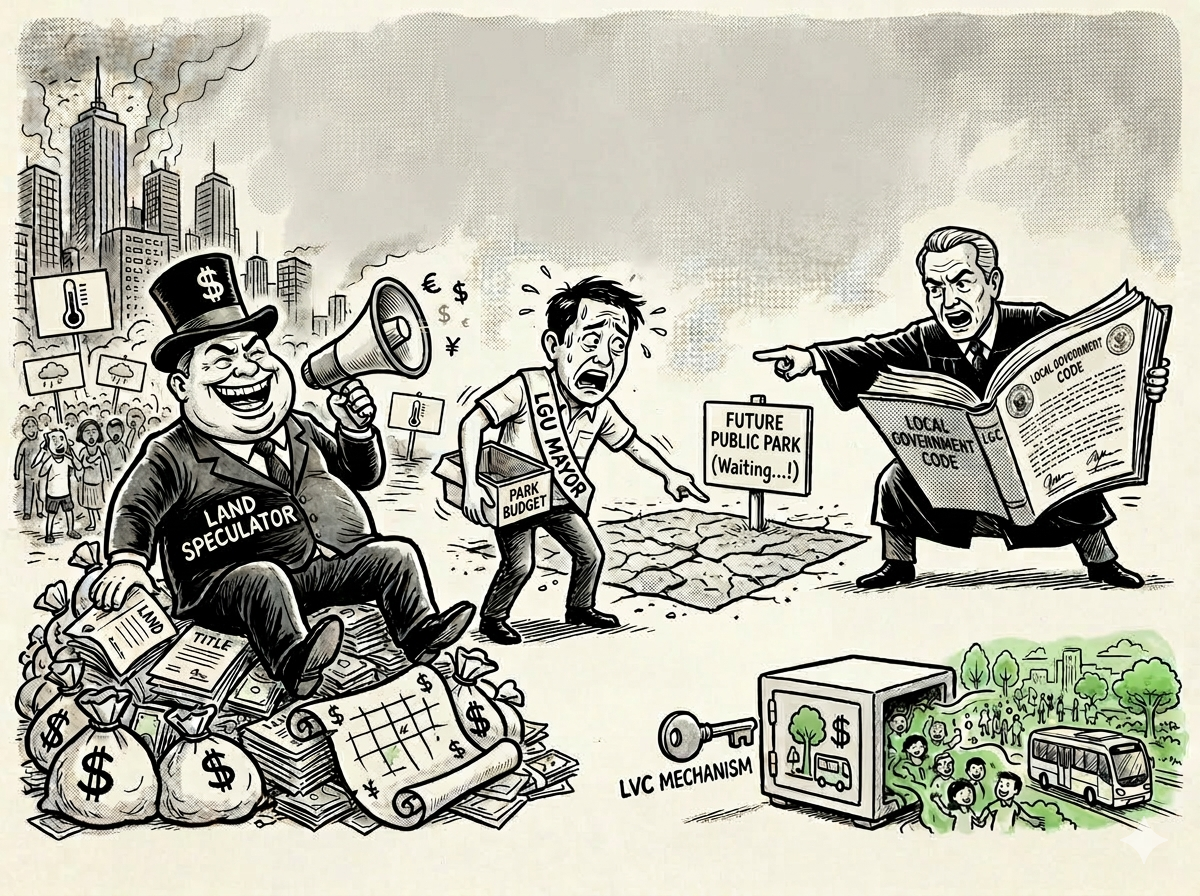
Land value capture (LVC) as a means to end “socialism for the rich, capitalism for the poor” dynamics in enjoyment of benefits of the land.
As the government pours billions into infrastructure, i.e., paving roads, installing utilities, and providing security, the value of that hoarded land skyrockets. When the LGU eventually realizes it needs a portion of that land for a public park or a transit terminal, they find themselves priced out of their own future. They are forced to buy back, at a massive premium, the very value their own public investments created.
This is the central irony of urban planning: the very transparency meant to foster orderly growth is the same tool used by private interests to make that growth unaffordable for the public.
Tapping the hidden wealth of land value capture (LVC)
The World Bank argues that is perhaps the most underutilized tool for sustainable urban development.
According to a World Bank study, when a city builds a new train line or a Bus Rapid Transit system, the land within a 500-meter radius of the stations experiences a dramatic surge in value. This increase is an "unearned increment," a profit that accrues to the landowner not through their own sweat or capital, but through the collective tax contributions of the citizenry. The Bank notes that in many developing nations, the failure to capture this value represents a massive transfer of public wealth into private hands, often exacerbating urban sprawl and starving public services of much-needed capital.
The tragedy of this situation is that we already have the cure here in our country. It has been sitting on our law books for over 30 years.
Section 240 of Republic Act No. 7160 ("Local Government Code of 1991") allows for a special levy, to wit: "A province, city, or municipality may impose a special levy on the lands comprised within its territorial jurisdiction specially benefited by the public works projects or improvements funded by the local government unit concerned."
This is the legal embodiment of LVC. The logic is simple and profoundly fair: if the value of your private land increases not because of any improvement you made, but because the government built a bridge or a park next to it, that "unearned increment" belongs to the public.
Under the Local Government Code of 1991, an LGU can recoup up to 60 percent of the increase in land value resulting from public works. If this were enacted via local ordinance, it would fundamentally change the math of speculation. If a speculator knows that a significant portion of their "windfall" will be taxed back to fund the very park that increased their land value in the first place, the incentive to hoard land evaporates.
Implementing this in our LGUs would provide three transformative benefits:
1. Funding for "Third Places." The revenue from special levies could be ring-fenced specifically for land banking and the development of public parks. The park would, in a sense, pay for itself.
2. Discouraging land hoarding and profiteering. It forces "productive" use of land. If holding onto vacant land becomes expensive because of the levy, owners are more likely to develop it or sell it to those who will.
3. Equity. It ends the "socialism for the rich, capitalism for the poor" dynamic where the public pays for the infrastructure, but the private owner pockets the profit.
A call for local courage
The obstacle to implementing a betterment tax or a special levy isn't a lack of law; it’s a lack of political will. Landowners are often the most influential constituents in any given municipality. Suggesting a tax on their "windfall" profits is a difficult political sell.
However, as our cities grow denser and the climate grows harsher, the status quo is becoming a death trap. LGUs must stop being the "unwitting accomplices" of land speculators. The CLUP should not be a cheat sheet for the wealthy to get wealthier; it should be a covenant between a city and its citizens. It is time to reclaim the value of our public investments and turn our "unearned increments" into the cool, green breath of a better future. ###
