Commons in the City
Starting last year, the green, manicured, and enclaved greens of the Club Intramuros Golf Course were opened to the public. Families wander where golfers once measured distances. Joggers trace the curve of fairways. Children run freely across a landscape that used to demand silence and membership.
Nothing dramatic happens. And that, precisely, is the point.
The scene unsettles a deeply held Filipino assumption: That public spaces, once opened, inevitably slide into chaos. That without gates, guards, or entry fees, order dissolves. That shared space is dangerous space. The unease surrounding the Intramuros experiment reveals how much of our urban thinking is shaped not by evidence, but by fear, and by class.
Urbanist Ray Oldenburg called places like parks, plazas, cafés, and sidewalks with chairs “third places.” They sit between home (first place) and work (second place), informal and unprogrammed, places where people gather simply because they can. Third places are where civic life becomes visible. They are not loud declarations of nationhood or culture; they are quiet rehearsals of coexistence.
In cities that take people seriously, third places cluster around transportation. Train stations open onto plazas. Bus stops spill into cafés and shaded sidewalks. Movement slows into presence. Transit doesn’t just move bodies; it delivers them into places worth arriving at.
Philippine cities, by contrast, are built to flee. Stations are corridors. Sidewalks are slivers. Waiting is treated as a design failure. We invest heavily in flyovers and road widening, and almost nothing in the social life that unfolds once people step out of vehicles. The result is a city that moves endlessly but rarely settles.
This imbalance is often explained in financial terms. Roads move goods. Cars signal progress. Public space, by contrast, feels indulgent. Something to add later, when we can afford it. But the logic is not purely economic. It is cultural, and it is classed.
There is a persistent belief that public spaces are for the poor. That parks, plazas, and open commons are where disorder gathers. The middle and upper classes respond by withdrawing into gated villages, guarded clubhouses, private gyms, and malls. Comfort becomes enclosed. Safety becomes filtered. Social life becomes curated.
This is why discussions about malls provoke such strong reactions. When an urban advocate argued recently that many malls, especially those built on reclaimed land, stand on territory that could have been public parks or waterfronts, she wasn’t romanticizing open space. She was pointing to a structural choice. Reclaimed land, by its nature, is newly made. It does not arrive preordained as commercial. It becomes what policy and power decide it will be.
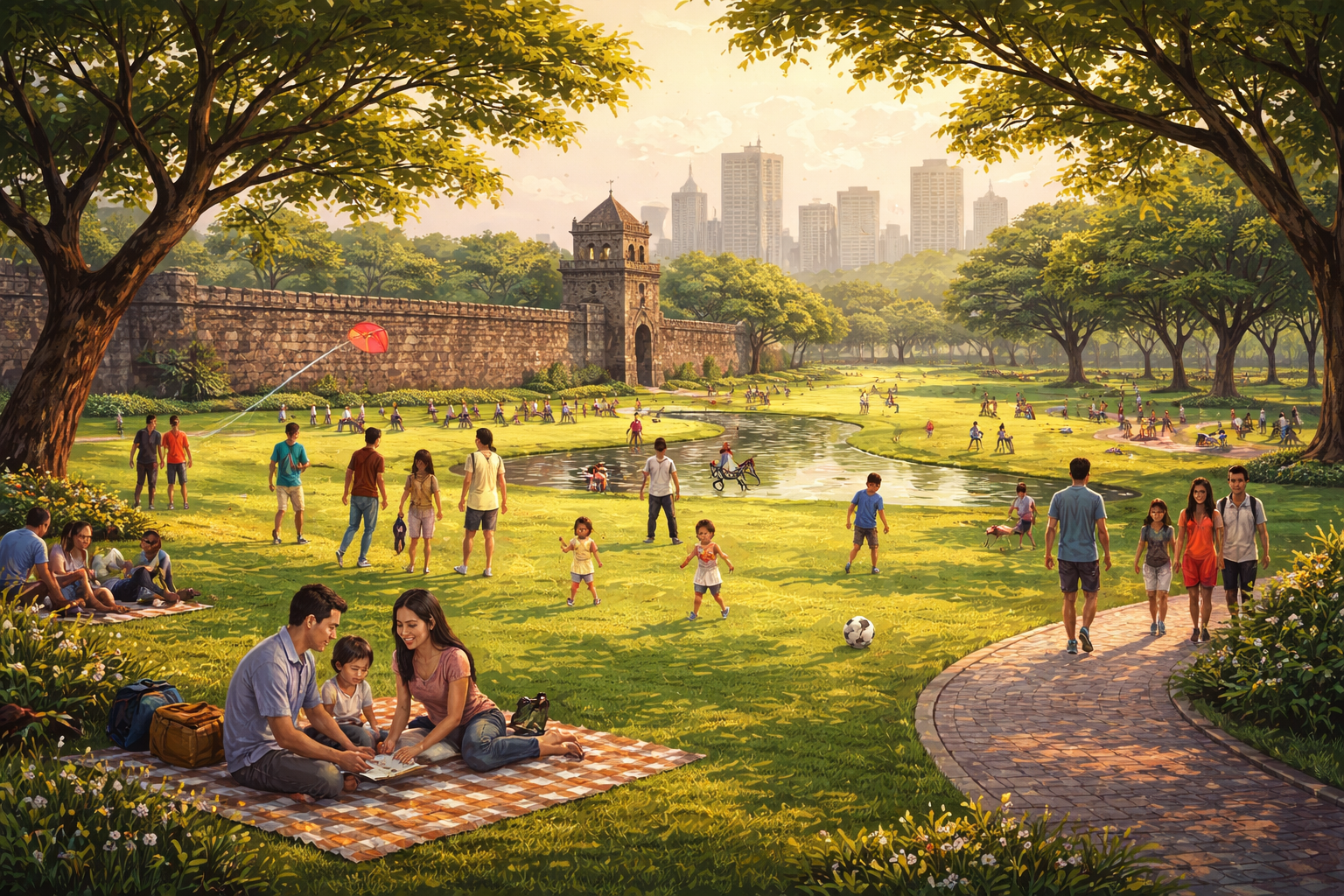
Opening a golf course once a week will not fix Metro Manila. Neither will turning every mall into a park. But these moments widen the imagination. They remind us that exclusivity is not an economic law. That order does not require walls. That public space is not the enemy of progress, but one of its foundations.
(The image to the left is AI-generated, illustrating the prospect of the enclosed greens of the golf course being a genuine public park and open space.)
The counterarguments came swiftly and predictably. Reclamation is expensive. It requires capital, long timelines, and risk. Governments need returns. Private developers provide them. Malls generate jobs, taxes, and revenue. Parks do not pay rent.
All of this is true. And yet it misses the deeper question: why do we insist that public life must justify itself in spreadsheets, while private profit rarely has to explain its social cost?
No one asks a flyover to prove its cultural value. No one demands that a parking structure demonstrate community-building outcomes. But a park must explain why it deserves land, money, and care. The imbalance reveals what we value and who we trust.
Malls flourish because they offer what cities refuse to provide: walkability, seating, toilets, shade, climate control, and a sense of safety, however managed. For many Filipinos, especially in dense urban areas, malls are the only places where walking feels possible and lingering feels allowed. In that sense, malls respond to a real need.
But they do so on private terms. Access is conditional. Behavior is monitored. Assembly is restricted. Protest is unwelcome. You may stay, but not too long. You may gather, but not too freely. You are a consumer first, a citizen second.
Over time, this arrangement reshapes expectations. We begin to believe that dignity must be purchased. That comfort must be enclosed. That shared space, by default, cannot be trusted. This belief feeds resistance to pedestrian streets, to public plazas near transit, to opening golf courses and exclusive landscapes to ordinary use. Mixing feels dangerous. Sharing feels like loss.
The irony is painful. What we fear as “chaos” is often the result of too little public space, not too much. When cities deny people places to gather, social life spills into whatever gaps remain—sidewalks, roads, informal edges. Disorder becomes a symptom of neglect. Then neglect is blamed on the people who were never given alternatives.
This is why the Club Intramuros Sunday opening matters beyond symbolism. It quietly disproves a story we tell ourselves. The space does not collapse into disorder. People walk, sit, take photos, bring children. They behave not like intruders, but like stewards. The experiment reveals a simple truth we often refuse to acknowledge: Filipinos are capable of sharing space when that space is designed with dignity.
It also reveals how hungry the city is for non-commercial places to exist. The popularity of car-free Sundays, temporary street closures, and pop-up parks points to a suppressed demand. When space is returned to people, they arrive not to vandalize, but to breathe.
Third places are not anti-development. They are not anti-investment. They are pro-city. They make density livable, transport humane, and difference ordinary. They do not eliminate inequality, but they soften its edges by forcing encounter.
Opening a golf course once a week will not fix Metro Manila. Neither will turning every mall into a park. But these moments widen the imagination. They remind us that exclusivity is not an economic law. That order does not require walls. That public space is not the enemy of progress, but one of its foundations.
The real challenge is not technical or financial. It is cultural. We have to unlearn the idea that public means chaotic, and confront the belief that dignity must be privatized. Until then, our cities will continue to move endlessly, without ever quite arriving anywhere worth staying. ###
